History
The Legend of Saint Barbara
Patron saint of artillerymen · Feast Day, December 4th
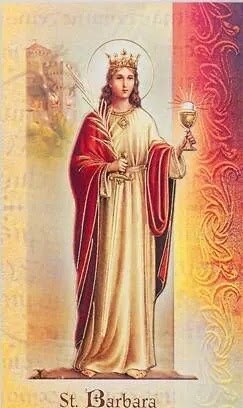
Around the world, Saint Barbara is recognized as the patron saint of field artillerymen. We associate her courage and steadfast faith with the qualities of those who have served the guns for centuries. Her feast day falls on December 4 — the anchor of every Saint Barbara's Day celebration, including the Gator Redleg Chapter's St. Barbara's Ball.
The Legend
According to legend, Barbara was the beautiful daughter of Dioscorus, a wealthy pagan nobleman of the Roman Empire who lived in Nicomedia in Asia Minor sometime in the third or fourth century. Her beauty was renowned, and suitors sought her hand — but her father, jealous and possessive, shut her away in a tower to keep her from the world and to limit her exposure to the new faith spreading through the empire.
Even imprisonment could not keep her from becoming a Christian. From her tower window she looked out upon the countryside, marveled at the living world around her, and concluded that the idols her family worshipped were false. She received instruction, was baptized, and refused every offer of marriage — including those from princes her father favored.
Shortly before embarking on a journey, Dioscorus commissioned a sumptuous bathhouse for his daughter, designed with two windows. While he was away, Barbara directed the builders to pierce a third window in the tower, symbolizing the Holy Trinity, and is said to have traced a cross in the sand of the bath. When her father returned and learned what she had done, he flew into a rage. Despite his threats, she refused to renounce her faith.
Dioscorus dragged Barbara before Marcian, the local prefect, who ordered her tortured and put to death. Her own father carried out the sentence, beheading her on a mountaintop. As he descended the mountain, a sudden violent storm broke over him. Lightning struck him down; only his scorched sword remained — divine vengeance, in the telling, for the murder of his daughter.
In later versions of the story, a shepherd betrays Barbara's hiding place after she flees her father. The place and year of her martyrdom vary across manuscripts: some place it in Heliopolis, others in Nicomedia; dates range from the mid-third century to around 306 A.D.
Tradition and History
Scholars note that Barbara's historicity is doubtful — she belongs to hagiography, the literature of saints' lives, rather than to verified history. Yet the legend took deep root. The cult of Saint Barbara began in the Eastern Church, with an early monastery at Edessa in the fourth century. She was known in Rome by the seventh century, and her veneration spread westward — notably when relics were translated from Rome to Ghent in 985. Accounts of her martyrdom were collected in Greek, Syriac, and Latin manuscripts from the ninth century onward, and her story was incorporated into the martyrologies of Western Europe.
She was numbered among the Fourteen Holy Helpers — saints invoked against various dangers and ailments — and became one of the most widely venerated martyrs in both East and West. A reported miracle in 1448, when a man named Henry Kock escaped a deadly fire at Gorkum by calling upon her name, further spread devotion to the saint.
G.K. Chesterton celebrated her in The Ballad of Saint Barbara (1922), written for “the saint of gunners, and a stay in sudden death.”
Ruin is a builder of windows; her legend witnesseth
Barbara, the saint of gunners, and a stay in sudden death.St. Barbara for the gunnery and God defend the right,
Building window upon window to our lady of the light.
St. Barbara of the Gunners, with her hand upon the gun.
Patroness of the Guns
The lightning that consumed Barbara's father linked her with sudden, violent death — thunderstorms, fire, and explosion. As gunpowder transformed warfare in the West, those who worked with it claimed her protection. Early cannon were notoriously unreliable: misfires, muzzle bursts, and exploding weapons were occupational hazards of the first gunners. Artillerymen began invoking Saint Barbara against the dangers of their trade.
Her patronage extended beyond the gun line. Armourers, gunsmiths, military engineers, and miners — as gunpowder came into underground work in the 1600s — all looked to Saint Barbara. Fireworks makers, architects, and those who labor where a spark can kill still number her among their protectors.
She is usually depicted standing beside a tower pierced with three windows, carrying the palm branch of a martyr. Icons often show her with a cannon at her feet or holding a chalice and sacramental wafer. She has protected us well ever since.
Saint Barbara's Day
The United States Field Artillery Association has long recognized the value of Barbara's legacy — not only the legend itself, but the celebrations and standards of excellence that bear her name. Saint Barbara's Day is the foremost occasion in the life of a Redleg: a chance to honor tradition, reinforce professional commitment, and gather with comrades.
Whether formatted as a dining-in, a dining-out, or a military ball, the objectives remain the same: enhance professionalism, build camaraderie, and promote the profession of arms. Reading the legend of Saint Barbara is an important part of every celebration, as is the presentation of the Orders of Saint Barbara and Molly Pitcher.
The Order of Saint Barbara
The U.S. Field Artillery Association and the Air Defense Artillery Association present the Order of Saint Barbara to recognize exceptional service to the artillery community. Two levels:
Honorable Order of Saint Barbara
Awarded to individuals who demonstrate the highest standards of integrity and moral character, outstanding professional competence, and selfless service to Army or Marine Corps Field Artillery.
Ancient Order of Saint Barbara
The more distinguished of the two, reserved for a select few whose long-term dedication embodies the spirit, dignity, and sacrifice of Saint Barbara herself — conspicuous lifetime service that stands above even their peers in the Honorable Order.